

7 Somber Blooms That Symbolize Death and Loss in Floral History
By Marina EgorovaWhich Flower Represents Death? It Depends on Where You Are
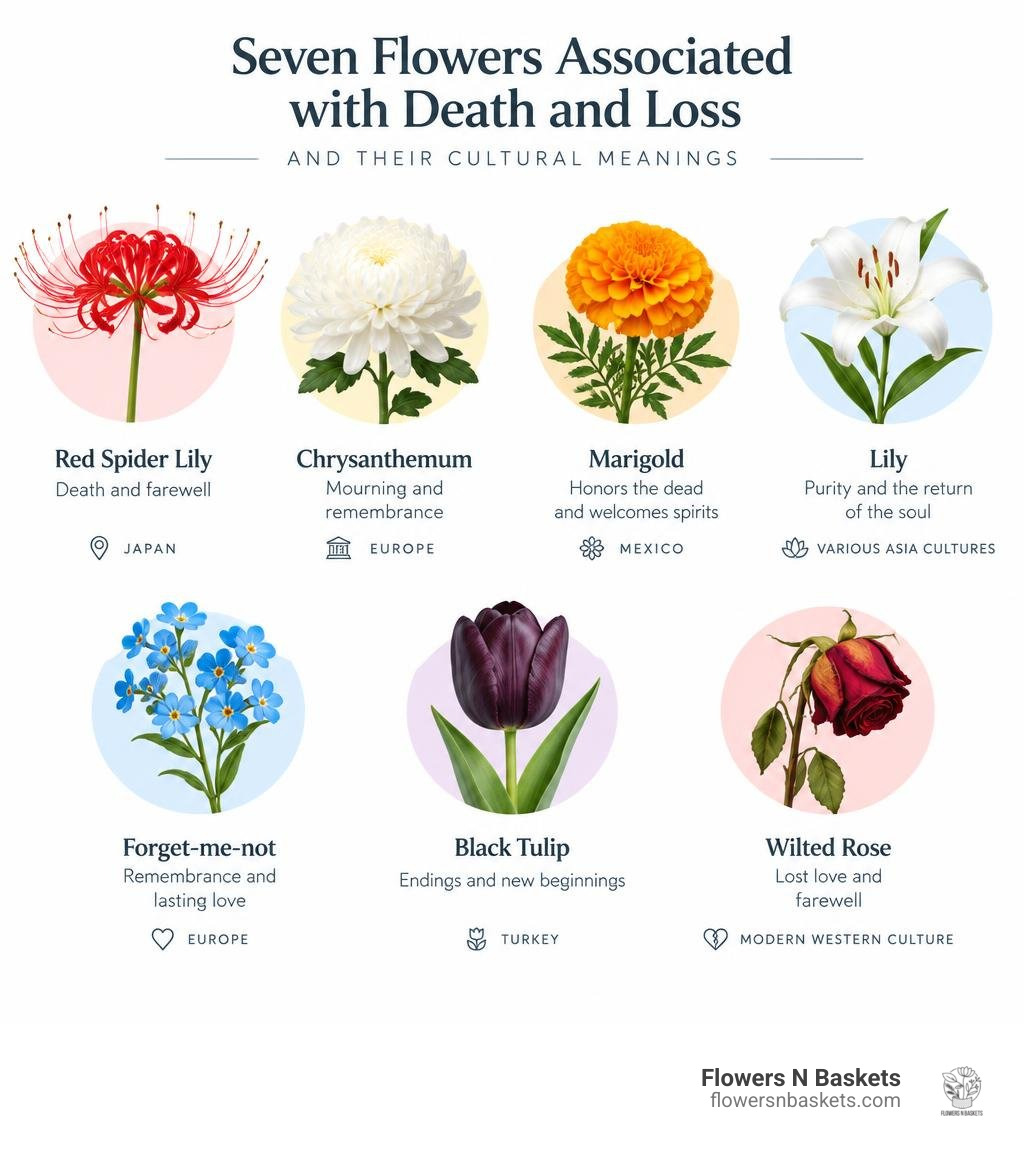
The red spider lily represents death and farewell in Japan. In much of Europe, chrysanthemums are closely tied to graves and mourning. In Mexico, bright marigolds honor the dead and help welcome their spirits during Day of the Dead. No single flower carries the same meaning everywhere.
This guide explores seven blooms linked to loss, from traditional funeral flowers to the wilted rose used in art and messages today. Knowing the difference can help you choose a tribute that feels thoughtful and fits the family's traditions.
The Rich History Behind a Flower That Represents Death Across Cultures
Long before floral symbolism filled poetry books, cemetery botany grew out of practical necessity and seasonal rhythms. Across ancient civilizations, planting specific blooms near burial sites served distinct purposes: protecting resting grounds from wildlife, marking sacred borders, and welcoming returning spirits during seasonal transitions.
In Asian and European folklore, botanical traits—such as blooming on bare stalks without foliage or opening exclusively during the autumn equinox—led observers to view certain plants as bridges between the physical world and the afterlife. In historical records, the folklore behind the Japanese afterlife guide reveals that plants blooming during equinox periods mirrored the spiritual crossing between earthly existence and ancestral realms.
| Flower Species | Primary Cultural Meaning | Native Region / Peak Bloom | Historical & Practical Origin |
|---|---|---|---|
| Red Spider Lily (Lycoris radiata) | Final farewell, reincarnation, afterlife passage | East Asia (Late September) | Planted around graves for poisonous bulbs that deter burrowing rodents. |
| Chrysanthemum (Chrysanthemum morifolium) | Mourning & grief (Europe); Longevity & royalty (Asia) | Global / East Asia (Autumn) | Blooming peak aligns with All Saints’ Day (Toussaint) cemetery visits. |
| Cempasúchil (Tagetes erecta) | Guiding departed souls back to living realms | Mesoamerica (October–November) | Ancient Aztec sun-flower used to illuminate spirit paths with scent and color. |
| White Lily (Lilium candidum) | Innocence restored to the departed soul | Mediterranean (Spring / Summer) | Classical Christian association with purity and the transition to heaven. |
| Black Rose (Rosa hybrid) | Tragic romance, rebirth, final parting | Global cultivation (Year-round) | Victorian mourning language and gothic literary expressions of closure. |
| Death Camas (Toxicoscordion venenosum) | Lethal omen, physical mortality | North America (Spring) | Wild botanical hazard carrying toxic zygacine alkaloids. |
| Wilted Rose (Symbolic / Vanitas) | Fleeting beauty, decay, heartbreak | Global iconography (Historic / Modern) | Dutch Golden Age still life paintings representing the certainty of death. |
7 Somber Blooms Associated with Mortality and Mourning
Floral history shows that humans have always used the natural lifecycle of plants to process grief. A single blossom can convey profound respect, an eternal farewell, or a hopeful reunion. Below are seven blooms historically tied to death, remembrance, and the fleeting nature of life.
1. Red Spider Lily: The Folklore of a Flower That Represents Death
Known botanically as Lycoris radiata and colloquially in Japan as Higanbana, the red spider lily is perhaps the most striking bloom linked to the underworld. Blooming for barely two weeks around the autumn equinox (September 22–23), its crimson petals emerge suddenly from bare soil without any accompanying foliage.

This unusual biological trait—where the vibrant blossoms wither completely before the green leaves ever sprout—gave rise to the poignant East Asian legend of Mañju and Saka. These two celestial spirits were assigned to guard the flowers and leaves separately; cursed by fate, they could never gaze upon one another. Thus, the bloom became a poignant emblem of lovers who will never meet again.
Beyond poetic sorrow, practical cemetery botany anchored its presence in burial grounds. The bulb of the spider lily contains lycorine, a toxic alkaloid. Centuries ago, before modern burial methods were standard, families planted these poisonous bulbs around earthen graves and rice paddy ridges to prevent moles, rodents, and wild animals from disturbing the ground. With over 100 folk names—including "ghost flower" and "hell flower"—the spider lily remains a powerful emblem of final separation and spiritual transition.
2. Chrysanthemum: Imperial Honor vs. European Funerary Taboo
The chrysanthemum is a fascinating study in cultural division. In France, Italy, Belgium, and Spain, bringing a bouquet of chrysanthemums to a dinner host is a serious social misstep. In these southern and western European cultures, chrysanthemums are exclusively cemetery flowers, brought to gravesides on November 1st for All Saints' Day (Toussaint). Because they naturally peak in late autumn when frost claims other garden plants, they became the universal symbol of mourning and honoring departed ancestors.
In stark contrast, East Asian cultures revere the chrysanthemum (Kiku) as an emblem of nobility, resilience, and vitality. In China, where it has been cultivated for more than 2,500 years, it represents scholarly virtue and long life. In Japan, a 16-petaled double chrysanthemum serves as the Imperial Crest (kiku no mon), appearing on government seals and national passports. When selecting funeral arrangements for diverse backgrounds, consulting our funeral flowers complete guide helps ensure every stem aligns seamlessly with traditional etiquette.
3. Cempasúchil (Mexican Marigold): Guiding Departed Souls
During the vibrant celebrations of Día de los Muertos in early November, the bright golden-orange blossoms of the cempasúchil (Tagetes erecta) transform Mexican cemeteries and family altars into luminous pathways. Originating from the Nahuatl term cempohualxochitl, meaning "twenty-petaled flower," this blossom has guided spirits for centuries.
Tracing the history of Mexico's flower of the dead reveals its ancient connection to Tonatiuh, the Aztec sun god. According to myth, the grieving lover Xóchitl was transformed into a marigold by the sun's rays so she could be reunited with her fallen warrior, Huitzilin.
Because the strong, musky scent and brilliant orange hue are believed to cut through the spiritual veil, families scatter marigold petals from cemetery gates straight to their home altars (ofrendas), creating aromatic trails that guide departed loved ones back for a night of reunion, music, and remembrance.
4. White Lily: Restored Innocence and Peaceful Passage
In Western and traditional Christian funerary customs, the white lily (Lilium candidum) stands as the premier symbol of peace, transition, and spiritual cleansing. The flower is believed to represent the soul of the deceased being restored to a state of pristine innocence and serenity upon departing the physical realm.

With their statuesque stems, trumpet-shaped petals, and majestic fragrance, white lilies bring quiet comfort to traditional funeral and church services. For local memorial gatherings, choosing pristine white blooms from our curated guide to white flowers for a funeral ensures a dignified aesthetic that conveys reverence, warmth, and enduring peace.
5. Black Rose: Gothic Elegance, Final Farewell, and Rebirth
While true pitch-black roses do not exist naturally in botany, extremely deep-red cultivars—such as the renowned 'Black Baccara' and 'Black Pearl'—appear completely dark under subtle lighting. During the Victorian era, when floriography (the language of flowers) governed courtship and social etiquette, a dark, near-black rose signified a final farewell, deep sorrow, or the absolute conclusion of an era.
Modern floral designers and memorial services frequently embrace these moody, velvety blooms for their dramatic elegance and symbolic depth. Far from representing purely somber themes, dark roses also symbolize rebirth, strength, and transformation. Incorporating custom tributes with black funeral flowers offers a contemporary, deeply artistic tribute for honoring unique, extraordinary lives.
6. Death Camas and Corpse Flower: Botanical Omens of Decay
Nature also produces wild plants whose mortality connections stem from biological hazard and carrion-mimicking survival adaptations:
- Death Camas (Toxicoscordion venenosum): A delicate, cream-colored wild bloom native to North American meadows that contains potent zygacine alkaloids. Historically mistaken for edible blue camas bulbs, it remains an omen of botanical danger.
- The Corpse Flower (Amorphophallus titanum): Producing one of the largest floral structures on the planet, this tropical plant blooms unpredictably once every several years. To attract flesh flies and carrion beetles for pollination, it releases an overwhelming scent of decaying matter, embodying mortality through pure botanical chemistry.
7. The Wilted Rose: From Vanitas Art to Digital Symbolism
The visual of a drooping, drying rose has represented impermanence (memento mori) for centuries. During the Dutch Golden Age of the 16th and 17th centuries, painters featured wilting flowers alongside skulls, hourglasses, and snuffed candles to remind viewers of the fleeting nature of worldly beauty and mortal life.
In modern communication, exploring the cultural meaning of the wilted flower emoji shows how this historical symbol evolved for digital spaces. Added to Unicode in 2016, the wilted rose glyph (🥀) serves as modern visual shorthand for grief, fading love, and melancholia, proving that our collective desire to represent loss through floral motifs remains as vibrant as ever.
Floral Gifting Rules and Modern Sympathy Etiquette
Sending condolence flowers requires a thoughtful balance between artistic beauty and cultural awareness. Because floral meanings vary across different heritages, keeping standard etiquette in mind helps your floral tribute offer genuine comfort.
Navigating International Floral Taboos
- European Etiquette: Avoid presenting chrysanthemums as social, birthday, or hostess gifts in France, Italy, Spain, or Belgium; reserve them strictly for memorial graveside visits.
- East Asian Traditions: In traditional Chinese, Korean, and Japanese customs, white flowers (particularly white chrysanthemums and white lilies) are customary for funerals, but red blooms should generally be avoided at mourning services as red is linked to joyous celebrations.
- Modern Thoughtfulness: When you want to convey heartfelt condolences, selecting comforting, custom sympathy flowers tailored with soft pastels, creams, and whites provides universal comfort to grieving families.
Choosing Respectful Arrangements for Memorial Services
Selecting the right arrangement style depends on the venue and your closeness to the family:
- Standing Sprays & Wreaths: Displayed prominently on easels near the casket during chapel or memorial services, typically sent by extended family, close friends, or business associates.
- Casket Sprays: Large floral blankets resting directly atop the casket, traditionally coordinated exclusively by immediate family members.
- Tabletop Baskets & Urn Tributes: Compact, thoughtful designs chosen from an elegant white funeral flowers collection, suitable for memorial services, cremation displays, or sent directly to the family's residence.
If you are unsure of what sentiment to write on the enclosure card, reviewing our guide on what to write on funeral flowers offers comforting, heartfelt phrasing ideas.
Frequently Asked Questions About Mourning Flowers
Which Bloom Is Universally Considered a Flower That Represents Death?
There is no single worldwide flower that universally represents death. In East Asia, the red spider lily (Higanbana) is the most recognizable symbol of the afterlife and eternal farewell. Across Southern and Western Europe, the chrysanthemum serves as the universal cemetery flower for All Saints' Day. In Mexican culture, the cempasúchil (marigold) holds that role during Día de los Muertos, while in Western traditions, white lilies represent peaceful passage and restored innocence.
Why Are Red Spider Lilies Planted Near Graves and Rice Fields?
Red spider lilies were traditionally planted around burial grounds and agricultural embankments due to the natural toxicity of their bulbs. Containing the alkaloid lycorine, the root systems deter burrowing rodents, moles, and wild animals from disturbing resting places. Their bloom time during the Buddhist autumn equinox (Ohigan) further reinforced their role as spiritual guardians of ancestral graves.
Is the Blue Spider Lily a Real Death Flower?
No, the blue spider lily does not exist in nature. The concept of a blue spider lily is entirely fictional, popularized globally by the anime and manga series Demon Slayer (Kimetsu no Yaiba). In the series, it is depicted as an elusive botanical cure, symbolizing unattainable immortality and forbidden power. In the natural world, spider lilies of the genus Lycoris bloom in red, white, yellow, and soft pink—never blue.
Honoring Loved Ones with Thoughtful Floral Expressions
Throughout human history, flowers have given us a quiet, eloquent language to express what words alone often cannot. Whether honoring centuries-old heritage through traditional white blooms or designing a custom memorial piece that reflects a loved one's unique personality, selecting the right floral design brings peace, reverence, and grace to every farewell.
At Flowers N Baskets, our in-house floral designers create custom floral tributes, sympathy baskets, and standing memorial pieces crafted with meticulous care. We provide reliable delivery throughout Palm Harbor, Tampa, Clearwater, St. Pete, Dunedin, and Tarpon Springs. To honor your loved one with a bespoke tribute, contact our local team to coordinate sympathy and funeral flower arrangements in Palm Harbor tailored to your family's needs.